


Can you Introduce yourself?
Edith: I’m Edith. I’m from Indonesia. I identify myself as non-binary masculine, My pronoun is they and them. and currently I am working independently as the counselors and also trying to figure out other modalities to do counseling through a dance and movement around 5 years for me to to become a well-being facilitator for different communities such as the queer and trans communities or also communities or activists from different regions such as the region where there are increased militarization, and also where the environmental has been abused. So yeah, I do different well-being sessions with the activists, working in environmental rights, and also indigenous rights. And also activists who work in gender based violence too.
And with the counseling, I start this in June, 2023. So I say that my services are for the queer and trans individual. I said that it is a queer affirmative therapy because I believe that each trans and queer deserves to have adequate services for themself. So that we can improve our well-being as a trans and queer individual and we can have the maximum capacity when we share or talk or feeling our vision, our works to words, our communities or even to a wider audience, wider society. So I have been doing this counseling for almost 2 years. And now slowly, I also figured out that counseling is not enough because like counseling you’re trying to build or unpack the way you think or the way you behave to cognitive activity, like through talking, but I feel that we need to go deeper on that by connecting our mind with also our body. And that’s how I feel that I need to go further, to also see that our body is not separated from our mind, That’s how I started to work on that
You see that the body is important, and how did you come up with that? For activists or anyone that fights, want to change society.
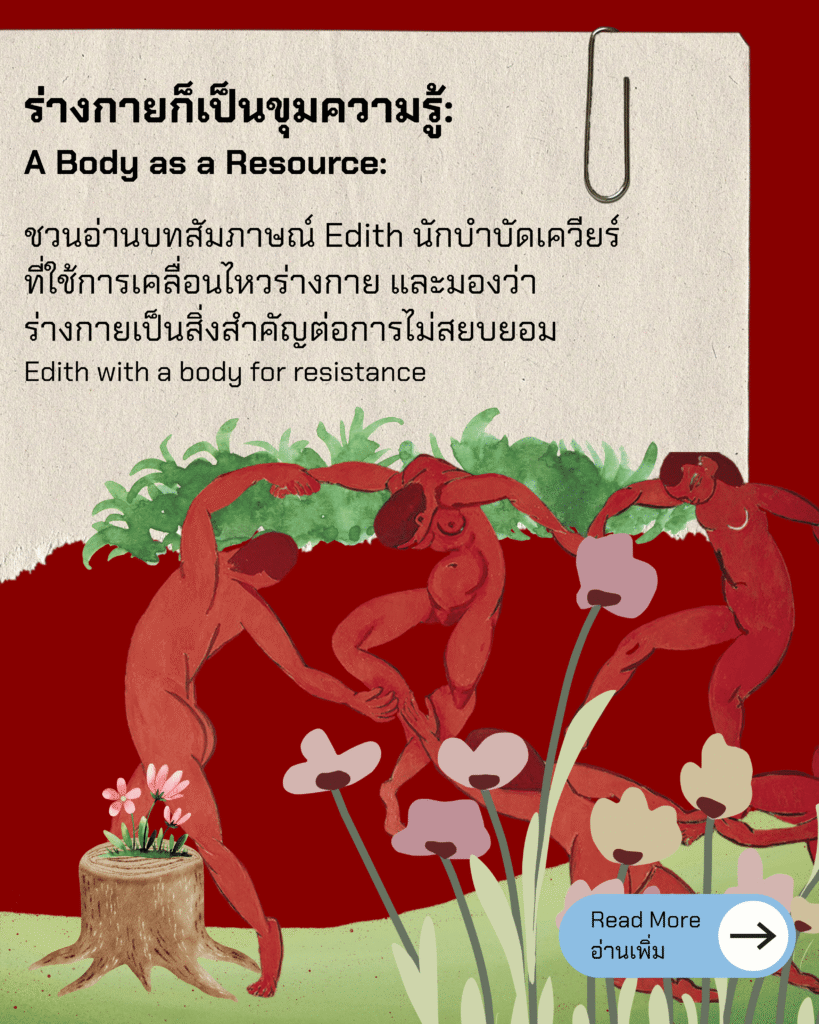
Edith: I feel that first of all, for in this society or in this system, I think not only activists but even like the people who struggling in their life, in the community also, like we are pushed to think a lot, you need to be rational, you need to be logical, you need to have deeper analyzing on certain things. This kind of reasoning makes us get isolated from our body, in which our body always carries us since we were born, right? And our body knows what happened to us like when we’re child, adolescent, until we grow up, until a certain age, until we’re getting old. So our body is also the center of knowledge, but in the society, even in the capitalist society, in the system, they really don’t care about our body. They only care about our body as a resource to be exploited like, okay your body has the strength so you can do certain activities legit to the labor, maybe you can move something because of your body. So all of these things that we do to the body always seem as an object, as lower than mind. So I think from that perspective, I want to highlight that no, our body is also the resource, there is a resource of wisdom, we have many memories in our body. And most of the things that we are experiencing, sometimes it can not be expressed in words. So that’s why I feel that by acknowledging, our body misses acknowledging our own wisdom, and actually our body already has wisdom and intelligence. For example, if we are in a trap, we feel not safe, our body can detect very easily, the simple thing is that when you touch the fire, your body can certainly feel the hot and then they can just immediately go form this track, form this unsafe, like oh the fire make me hot so I need to go away from this danger. So in the system, our system, also like there are many things that can not be rationalized or maybe the brain will come later on, but our body will start to sense. Oh! The situation is hot, the temperature is cold, so what should I do about this? Oh, I feel comfortable when I feel safe, I don’t feel comfortable when I stand up. So these kinds of information come from our body.
Especially, when you are queer or trans, first you can feel detached from your body because the society told you not to see yourself as a whole individual, maybe ‘cause your gender expression is very different so you should change it, but actually you know exactly what your body wants or what do your body feel not good about yourself. When someone approaches you and you feel that they are not a safe space for me to tell them about my identity, or tell them about my relationship with someone that I like. So our body always knows. But the wisdom has never been refilled because there is a comparison between, oh you should use your mind not your body. So from that perspective I feel that activists also need that, because I, myself, feel that if I know my body, for example, if I know that I have to face a difficult situation so I know how to tempt my body, how to listen to my body. Because I also see myself as a community organiser and I also see that I will face difficult situations where, maybe when I need to listen to difficult stories, or maybe I need to help someone with the suffering or physical pain, so I can not look away from them, right? At the same time, I also need to listen to what happened to my body. Because the process of listening to people, the process of assisting people, can also bring secondary trauma or burn out or maybe their experiences also connect to our own experience that make us feel like oh, I can not handle this. Usually it will be start in our body, the emotion, and that’s why starting with letting yourself aware with your body signals is a good way to understand oh, what happened with me, okay I feel pain certain part because of what, maybe we don’t know the reason yet but at least we are getting of more aware our body parts, and then we can figure it out how to use our body too, as a resource, if we want to feel more relax, more grounded, because yes! Our body has a lot of wisdom and not only restores the trauma but also stores the joy, and they know how to make us feel grounded and relaxed. You can also think, for an example, when you feel anxious even you didn’t learn about dance movement therapy, our body already know the respond like if you feel like anxious, you want to present something in front of people maybe your hand will feel wet and you suddenly pull your hand under your feet, for example, and you suddenly swaying movement. It is the thing that your brain doesn’t tell you logically but your body knows how to make yourself feel a little bit comfortable. So I think that’s how dance movement therapy wants to explore.
Yes, we have such a certain way to respond when there is a threat, for example, like oh, I will go freeze or oh! I will shout or like my body will feel strongly tense, but actually our body also knows how to feel relaxed when we feel tense, when we feel freeze and so on. So that’s why I think the activists need that because we always maybe find more time when we are in crisis rather than in the so called easy time. So if we can resource ourselves, like we know that my body feels tired so what subtle shift is, what subtle moves can I do when I immediately feel tired. Do I need to lean on? Or I need to take a deep breath or a water first or get the will to make us or activists know if they feel a little tired and how to shift the body respond.
I also feel interested in dance because it is not always a movement but also dance. Dance is very connected to the culture, like everyone dances, in Indonesia even when someone is getting born everyone celebrates by dancing, even when someone has passed away there is also some tradition in my country that people also dance. So dancing is very tribal and very connected to the ancestor, it is like our birth tribe – for me. There is this kind of connection between movement, random movement but also dance, there are more cultural things that have certain meanings. So dance could be part of the way that you go through your restorative healing path because what was introduced into some kind of dance when we were children is connected to our tradition perhaps or connected to our ancestors. That’s why dance and movement become the package when it comes to making the body get the resources or understand the resources within themselves.
Do you have a specific dance or movement that is your favorite or whatever that happened in the moment? For both during the sessions and for yourself.
Edith: So usually for the group session, I don’t have specific references to facilitate. So usually in the session I will focus on how, for example, we can start connect with our body first usually it will come from our five senses although, we have sixth sense actually, but at least form five senses from what you see, what you smell, what you hear, what you touch, because that’s how we understand about the environment. Sometimes it is difficult to just go straight to your body because oh, I will face my body in the way that society never allows us or never gives us more opportunity to explore the body. So the way that I will do in the group session usually will start from the environment first because that is how our body starts to sense, oh! Maybe the environment feels quite safe for me to feel relatively comfortable, like this texture makes me feel okay, or I can see certain light that makes me feel comfortable, or there is a certain sound that makes me familiar. Because our body tries to have the radar, they try to radar whether the environment is safe or not, and usually it starts from the senses so I will start from there, from the senses, and then start to go to continue to the breath, usually it goes by the regular breath, like sometimes people feel worried when they need to okay make the deep breath and then exhale because everyone has different relationship with breath, right? So the second thing will go to the breath like just notice, what you notice when you have a regular breathing, but it is more consciously to just notice it because we breathe every time but sometimes we don’t realize, most of the time we don’t realize that we are breathing.
After that, starting to move with the body part that makes us feel comfortable. Usually the body part that makes us comfortable is what I say as the details, the body part that is outside us, like far to our torso. It will be like fingers, or toes, so we can start to move from the more accessible body part. And from there we can continue to the difficult part, everyone can have different ways maybe the most accessible part to move is like stomping, for example, stomping their feet, maybe for others – no, I can’t, I don’t feel easy to stomp my feet, I feel easy to sway with my fingers. There is no particular movement that I will introduce, but from there they will know which body part that I can use to start to move, and that for the group session. But also usually in the group session, I will use the music as the property so for the music it will depend on the objective. For example, if you want to have a slow focus, I will use the more slow beat or maybe music like acapella with a sound like dum dum dum or like hmm humming. But if I want to make the body feel activated, then I will choose more remix music, so it depends on the aim of each subsession.
For myself, because I identify as a non-binary demi-masc, I have a challenge with my upper body especially with my chest. I notice that the most accessible part of my body is my lower body, so I start to stomp my feet and then when I feel more flowy when I stomp my feet then it reminds me about some connection with my previous preference of music. So I link my stomping with Hip-hop, because I like hip-hop in my adolescent time so when I get stressed out I will listen to hip-hop music. From there, I started to explore the connection of stomping and then hip-hop music. During my adolescent time, I listened to hip-hop music but I didn’t move. I didn’t move the rhythm, so my body remembers but my body didn’t know how to do with this rhythm but actually I like that. That’s why I explore more about the connection between stomping and hip-hop music. I’m still doing it, I’m still exercising it, because some of the hip-hop basic steps are more about the reflected stomping and also gliding, and maybe like the way that you can have the strong and direct movement but also there is a gliding that your feet glide like that. It is like direct but sustain, this kind of exploration makes me know different ways on how to connect with my body, for example, where’s the situation that I need to stomp, where’s the situation that I need to glide, what glide means to me, what feelings arrive when I stomp my feet and that’s how I try to connect it with my daily life. And that’s what I also want to introduce to my participants when they are in the session, hopefully they can find their resource which kind of movement that feels connected to which feeling, if they can have certain movements that really connect to their own experiences, their daily experiences, and use it in their daily life.
Apart from group sessions, do you do one on one sessions as well? Or do you have any kind of procedures to the session like any specific steps that you take to make sure that, for example, some participants might not feel up to dancing or moving their body right away.
Edith: Yeah, because I will finish my training this month, I already think about that. But last month, I started to offer the individual online session, so they can decide whether they want to have it. I only want to have one session that’s okay, but I will recommend having at least three sessions because there is a relationship we have builded, right? Between myself and the participants that want to join in. For now I opened for the online session and also for the in person but the in person they are still not opening yet because I’m still preparing for my small studio for people to come. What about the procedure is that usually I will send the form saying about what dance movement therapy is. Before they book their session, I will provide 40 minutes or 3 consultation just to know my face, because people will soon know their to whom that they want to build relationship with, especially it comes to the personal therapy and to ask about what their goals are, what is your intension, and after this session finish then they can think maybe no, this is not right for me I don’t want to do it, it is okay.